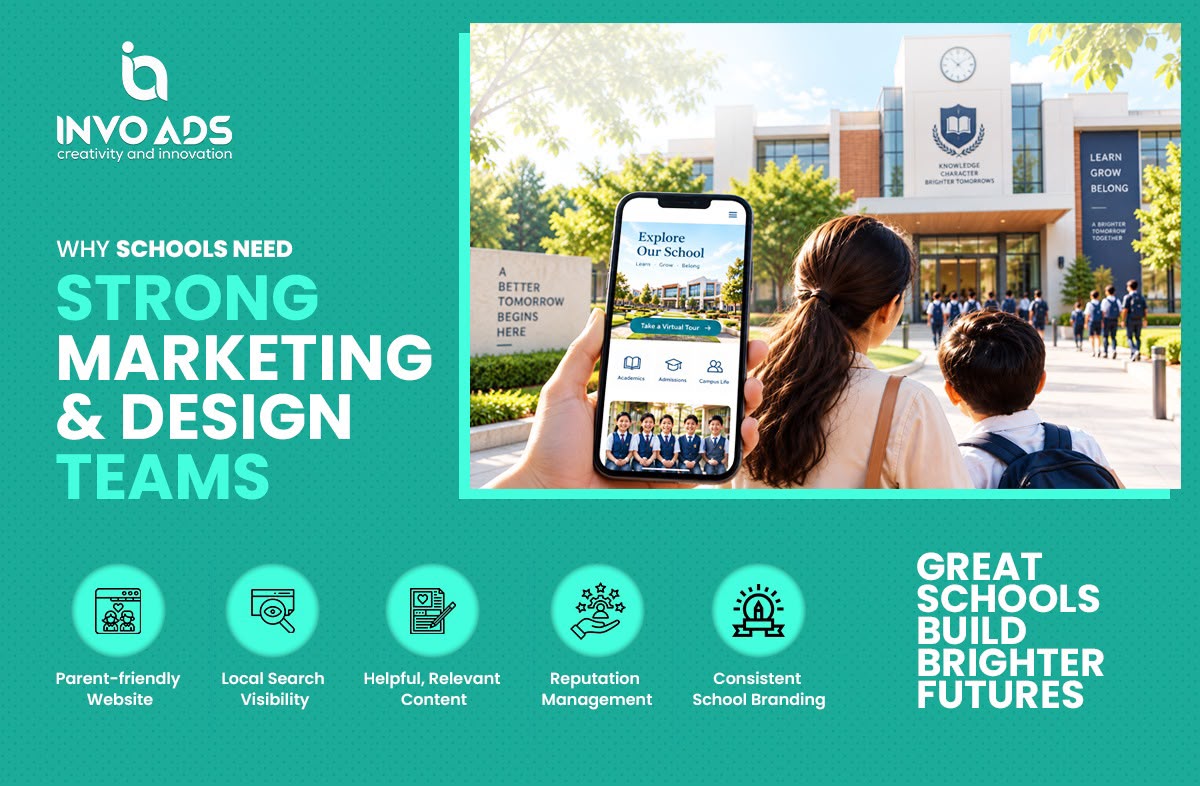
Admissions season starts long before parents fill out a form it starts the moment they search your school’s name online. What they find in those first few clicks often decides whether they even visit campus.
A dedicated marketing and design team gives a school a professional website, clear admissions information, and consistent local visibility turning curious parents into campus visits and, ultimately, enrolled students.
Parents research schools the way they research everything else now
Choosing a school used to rely heavily on word of mouth and physical brochures handed out in the neighborhood. That’s still part of the picture, but it’s no longer where the decision starts. Today, a parent evaluating schools typically:
- Searches for schools in their area or by board/curriculum (CBSE, ICSE, IB, State board)
- Visits the school’s website to check fees, curriculum, facilities, and faculty
- Looks at photos and videos of the campus, classrooms, and student activities
- Reads Google reviews from other parents
- Compares 2-3 shortlisted schools before booking a campus visit
- Increasingly asks AI tools questions like “best CBSE schools near [area] with good sports facilities”
If the website is outdated, hard to navigate on a phone, or missing basic admissions information, many parents won’t call to ask they’ll simply move to the next school on their list.
What a marketing and design team actually delivers for a school
1. A website parents can trust and navigate easily
A school’s website is often the first real impression of the institution’s quality, even before a campus visit. It needs:
- Clear admissions information: process, fee structure, eligibility, and important dates, without requiring a phone call to find basics
- Faculty and leadership profiles that build confidence in academic quality
- Photos and videos of real campus life classrooms, labs, sports, events not generic stock imagery
- Mobile-friendly design, since most parents will first browse from a phone
- Fast load times, since a slow site reads as neglect
2. Local visibility when families are actively searching
School searches are highly local and seasonal, spiking sharply around admission periods. Winning this visibility requires:
- A complete, accurate Google Business Profile with correct categories, photos, and admissions contact details
- Consistent name, address, and phone number across the website, directories, and social pages
- Location- and curriculum-specific content (“CBSE school in [locality]”, “best schools near [area] for primary admissions”) that’s genuinely informative, not just keyword-stuffed
3. Content that answers the questions parents actually have
Parents rarely search for generic terms like “good school” they search with specific concerns in mind. Content that speaks to those directly performs far better in both traditional search and AI-generated answers:
- FAQ sections addressing admissions criteria, transport, fee payment options, and extracurricular offerings
- Blog posts on topics like exam preparation tips, parent-teacher engagement, or extracurricular achievements these build authority and give parents a reason to trust the institution beyond admissions pages
- Clear “Apply Now” or “Schedule a Visit” pathways on every relevant page
4. Reputation management as an ongoing effort
Reviews from current and past parents are one of the most influential factors in a school choice, and they also shape how AI tools describe a school when parents ask for recommendations. A marketing team should:
- Encourage reviews from satisfied parents, particularly around admission and results seasons
- Respond to feedback both positive and critical professionally
- Monitor mentions across Google, parenting forums, and social media groups
5. Consistent branding across every parent touchpoint
A school’s brand appears on its website, prospectus, signage, uniforms, social media, and event banners. A dedicated design team ensures this stays consistent and professional, which reinforces the sense of a well-run, credible institution something parents are actively evaluating, often without realizing it.
Why this affects enrollment, not just image
Schools that under-invest in their digital presence are often competing against institutions with similar academics but stronger visibility schools that simply made it easier for parents to find, trust, and act on information. A structured marketing and design partnership directly affects admissions inquiries and campus visit bookings, not just how polished the school looks on paper.
Frequently asked questions
Does a small or mid-sized school really need a dedicated marketing team? Yes school choice is a high-stakes, research-heavy decision for parents. Even schools with excellent academics lose prospective families simply because information wasn’t easy to find or trust online.
What’s different about marketing a school compared to a regular business? Parents are evaluating trust, safety, and long-term outcomes for their child, so messaging needs to be reassuring, accurate, and specific rather than purely promotional. Photos and testimonials of real students and staff matter more than generic marketing language.
When should schools ramp up their marketing efforts? Ideally marketing runs year-round with content and reputation-building, but it should intensify 2-3 months before the main admissions window to capture peak search interest.
Should schools invest in social media too? Yes social media works well for schools to showcase events, achievements, and campus life, which builds familiarity and trust well before a parent visits the admissions page.
Invo Ads has worked with schools including St. Mary’s Public School and Oxford School, Nagarbhavi, to build websites, branding, and admissions-ready digital presence. If your school’s online presence isn’t reflecting the quality of education you provide, get in touch to talk through where to start.